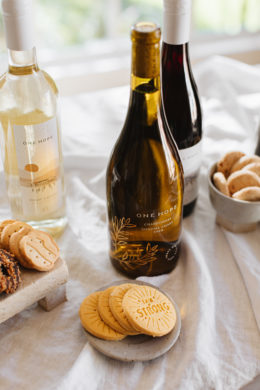
Hi ONEHOPE friends and family! We feel driven to share the imperfections of the world via how we’re going to help them. We don’t expect you to know anything about the causes we support, we don’t expect you to know anything about wine. In fact, not everyone in our company knows everything about these categories. But we do hope that you will listen and allow us to guide you through something new.

I’m Lauren Breuning, Social Media Director at ONEHOPE Wine and I’m going to interview our in house Mother Teresa, ONEHOPE Foundation Director, Melissa Levick to really find out WHAT IS AUTISM?
Lauren: What’s Autism?
Melissa: According to wikipedia, Autism is a disorder of neural development characterized by impaired social interaction and communication, and by restricted and repetitive behavior. Autism affects information processing in the brain by altering how nerve cells and their synapses connect and organize; how this occurs is not well understood.
Lauren: What the heck does that mean?
Melissa: Autism a very general term for very complex disorders of the brain. They are characterized by difficulties in social interaction, verbal and nonverbal communication and repetitive behaviors.
Lauren: Who has Autism?
Melissa: Around 1 in 88 American children are on the autism spectrum–a ten-fold increase in prevalence in 40 years. Careful research shows that this increase is only partly explained by improved diagnosis and awareness. Studies also show that autism is four to five times more common among boys than girls. An estimated 1 out of 54 boys and 1 in 252 girls are diagnosed with autism in the United States.
Lauren: How/ when do you get Autism?
Melissa: Autism first appears during infancy or childhood, and generally follows a steady course without remission. Overt symptoms gradually begin after the age of six months, become established by age two or three years, and tend to continue through adulthood, although often in more muted form. It is distinguished not by a single symptom, but by a characteristic triad of symptoms: impairments in social interaction; impairments in communication; and restricted interests and repetitive behavior. Other aspects, such as atypical eating, are also common but are not essential for diagnosis.
Lauren: What is life like for someone with Autism?
Melissa: Kids with autism experience the world differently than do other children — they may have a hard time dealing with or making sense of the sights, sounds, smells and other sensations that surround us all. Autism may also make it difficult for that child to talk, play, go to school or socialize — at least in any way that makes sense to the rest of us. The range of autism spectrum disorder is extremely broad — some children are only mildly affected, while others have a severe disability. Here are some examples of symptoms that may appear within a child with Autism:
Child A: Adores/obsesses about trains; can’t stand the feel of most clothing against his skin; severe speech delay; refuses eye contact; benefits from firm pressure (weighted vests and blankets, being held tightly by someone he trusts) and loves to jump up and down.
Child B: Talks all the time, but mainly just parroting everything he hears; scared of loud noises; exceptional recall and artistic abilities; limited eye contact; flaps hands; fascinated by numbers; runs off every chance he gets and has no concept of danger.
Child C: No speech skills; spends much of his time rocking back and forth; minimal eye contact; obsessively arranges and rearranges his toys while ignoring the remainder of the world; still not fully potty-trained at age 11; can complete a puzzle of the USA in two minutes flat.
Child D: Advanced verbal skills, and talks non-stop about every facet of dinosaurs; good eye contact; many obsessive-compulsive traits (will only eat white food or one very specific brand and variety of juice); prone to tantrums and head-banging; will happily wander off from his parents whether at the museum or shopping mall.
Lauren: As an average 29 year old living in Los Angeles, how can I help?
Melissa: There are many ways to get involved! First off, ONEHOPE Cabernet Sauvignon supports children with autism, where every 6 cases provides an hour of behavioral therapy. This is a wonderful way to support families and children with autism by doing something you already do!
Second, there is the ACT Today 5k/10k Run on April 6 in San Diego. This is an incredible way to get involved, get out in the sunshine, and raise funds for our partner organization. You can also donate directly to them through the ONEHOPE Foundation at www.onehopefoundation.org/donate.
Lauren: Thanks everyone for reading and showing your passion for helping others. If you have any more questions about the cause, do not every hesitate to ask! Stop by our facebook, twitter and instagram pages and keep in touch!